Beyond Evolution: Revolution
The difference between neural rendering and traditional CGI isn't incremental. It's not CGI 2.0. It's an entirely different universe of possibility.
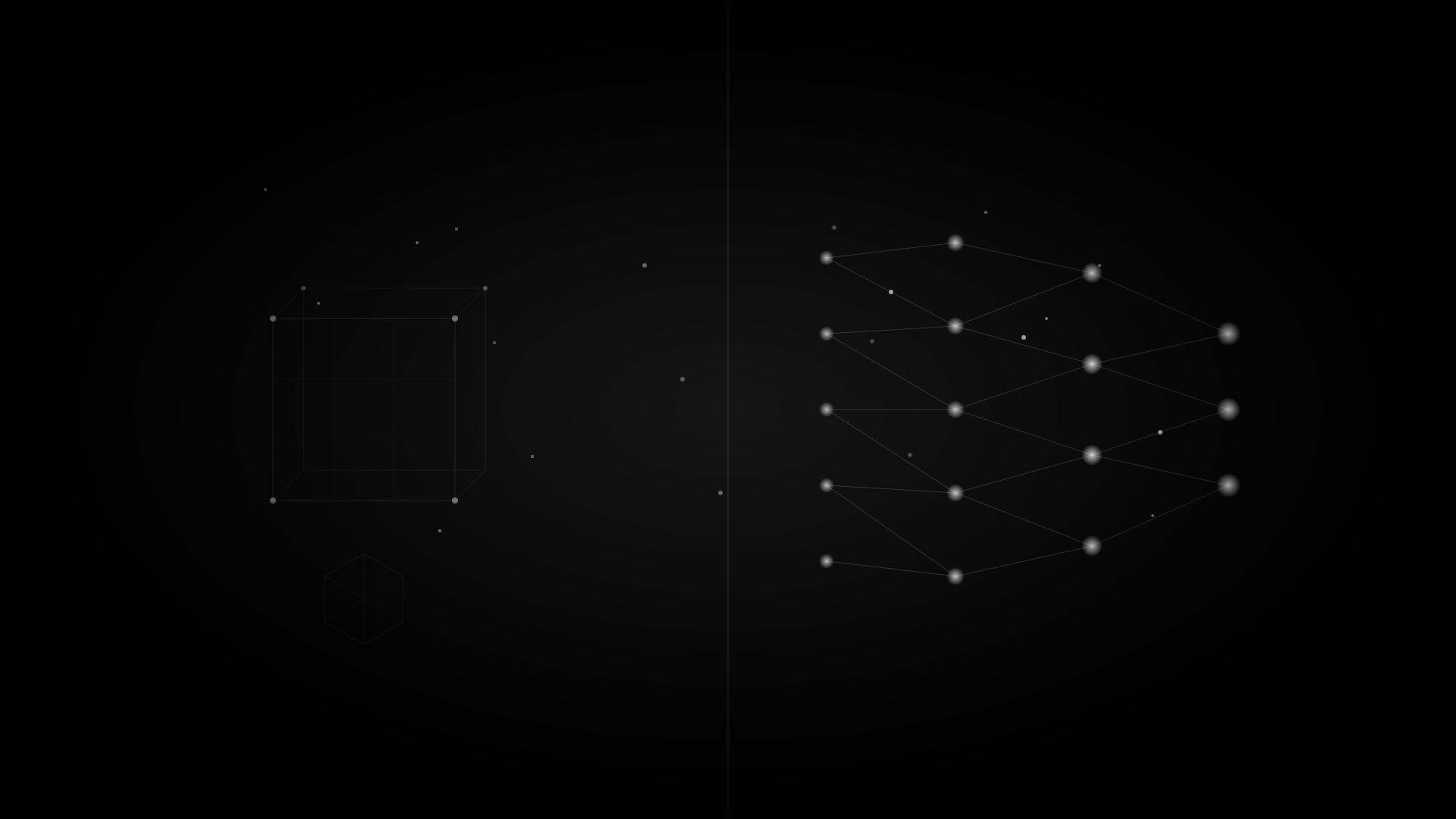
Traditional CGI builds reality piece by piece. Neural rendering dreams it into existence.
The Fundamental Paradigm
Traditional CGI: Construction
- Process: Build geometry → Apply textures → Set up lighting → Render
- Mindset: "How do we recreate reality?"
- Constraints: Physics simulation, polygon counts, render times
- Output: Approximation of reality
Neural Rendering: Manifestation
- Process: Vision → Neural interpretation → Instant materialization
- Mindset: "What reality do we want?"
- Constraints: Only imagination
- Output: New realities that never existed
The Technical Chasm
CGI: The Polygon Prison
Traditional CGI lives and dies by polygons:
Object complexity = Polygon count = Render time = Cost
Every detail must be manually modeled. Every surface meticulously textured. Every light source calculated. The more complex your vision, the more exponentially expensive it becomes.
Real-world impact:
- A single CGI creature: 6 months of modeling
- A detailed environment: 100+ artists
- A hero shot: 48-hour render times
Neural Rendering: The Probability Field
Neural rendering doesn't build—it understands:
Vision → Latent space → Probability distribution → Reality synthesis
The AI doesn't need to know how to model every leaf on a tree. It understands "tree-ness" at a fundamental level and can generate infinite variations instantly.
Real-world impact:
- Any creature: Hours from concept
- Any environment: Single artist directing AI
- Any shot: Real-time generation
Breaking the Uncanny Valley
CGI's Eternal Struggle
Traditional CGI has fought the uncanny valley for decades:
- Subsurface scattering for skin
- Complex shader networks for eyes
- Muscle simulation systems
- Still somehow... off
The more realistic CGI tries to be, the more our brains detect its artificiality.
Neural Rendering's Natural Advantage
Neural networks trained on reality understand the subtle chaos that makes things real:
- Imperfect symmetry
- Micro-movements
- Atmospheric inconsistencies
- The beautiful randomness of reality
The AI doesn't recreate reality—it channels its essence.
Speed: Orders of Magnitude
Traditional Pipeline Bottlenecks
CGI Production Timeline:
- Concept art: 2 weeks
- 3D modeling: 8 weeks
- Texturing: 4 weeks
- Rigging: 3 weeks
- Animation: 6 weeks
- Lighting: 2 weeks
- Rendering: 3 weeks
- Compositing: 2 weeks
Total: 30 weeks minimum
Neural Speed
Neural Rendering Timeline:
- Concept to first result: 2 hours
- Iterations and refinement: 24 hours
- Final perfection: 24 hours
Total: 48 hours maximum
We're not talking about 2x faster. We're talking about 100x faster.
The Impossibility Factor
CGI: Bound by Virtual Physics
Even in CGI, you're constrained:
- Rendering engines expect logical light behavior
- Geometry must be mathematically consistent
- Physics simulations follow real-world rules
You can break these rules, but it requires extensive technical workarounds.
Neural: Physics Optional
Neural rendering has no preconceptions:
- Light that casts multiple shadows in different colors? Natural.
- Geometry that's different from every angle? Simple.
- Water flowing upward while rain falls sideways? Just another Tuesday.
The AI doesn't know these things are "impossible"—it just creates them.
Real-World Comparison
Project: Luxury Car in Impossible Environment
CGI Approach:
- Model car: 3 weeks ($50,000)
- Create environment: 4 weeks ($80,000)
- Lighting setup: 1 week ($15,000)
- Rendering: 1 week ($10,000)
- Post-production: 1 week ($15,000)
- Total: 10 weeks, $170,000
Neural Rendering Approach:
- Generate car and environment: 4 hours
- Perfect lighting and mood: 4 hours
- Iterations based on feedback: 16 hours
- Final delivery: 24 hours
- Total: 48 hours, $15,000
Same quality. Different universe of efficiency.
The Creative Implications
CGI: Technical Barriers to Vision
Every creative decision in CGI has technical consequences:
- "Can we add more trees?" (Checks render time)
- "Can the water be more mystical?" (Calls technical director)
- "Can we try a different angle?" (Recalculates entire scene)
Neural: Vision Without Friction
Every creative decision is just... a decision:
- "Add a thousand trees" (Done in seconds)
- "Make water that glows from within" (Already generating)
- "Show me 50 angles" (Here they are)
The Learning Curve Revolution
CGI Mastery: A Decade's Journey
- 3D modeling: 2 years to proficiency
- Texturing and shading: 1 year
- Lighting: 2 years
- Animation: 3 years
- Rendering optimization: 2 years
Total: 10 years to become a senior CGI artist
Neural Direction: Weeks to Impact
- Understanding prompting: 1 week
- Mastering iteration: 2 weeks
- Developing aesthetic control: 2 weeks
- Advanced techniques: 3 weeks
Total: 2 months to create impossible worlds
Quality: Different Dimensions
CGI Quality Metrics:
- Polygon density
- Texture resolution
- Shader complexity
- Render samples
Neural Quality Metrics:
- Emotional resonance
- Atmospheric truth
- Impossible beauty
- Dreamlike coherence
We're not measuring the same things because we're not creating the same things.
The Hybrid Future (That's Already Here)
The future isn't neural rendering OR CGI—it's neural rendering making CGI obsolete for most use cases, while CGI becomes a specialized tool for specific technical requirements.
CGI's Remaining Strongholds:
- Technical visualization requiring exact specifications
- Scientific accuracy simulations
- Legacy pipeline integration
Neural Rendering's Expanding Domain:
- Everything else
The Economics Can't Be Ignored
Studio Reality Check
- CGI artist salary: $80,000-150,000/year
- Team of 50: $5 million/year
- Software licenses: $500,000/year
- Render farm: $2 million/year
- Total: $7.5 million/year minimum
Neural Reality
- Neural rendering artist: $100,000-180,000/year
- Team of 5: $750,000/year
- Cloud computing: $200,000/year
- Total: $950,000/year maximum
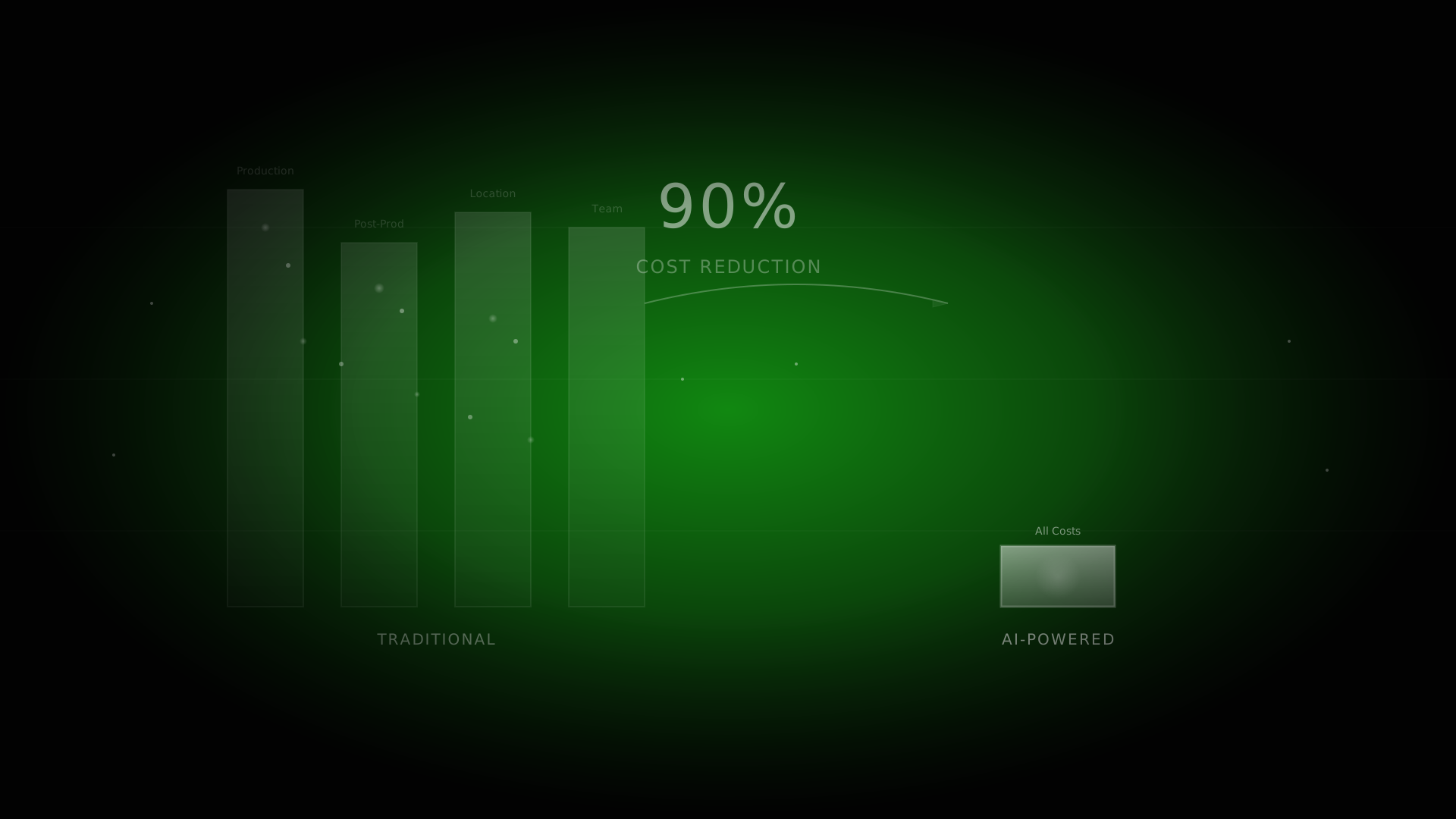
10x fewer people. 8x lower cost. 100x faster delivery.
Why This Matters Now
This isn't theoretical. While traditional studios cling to familiar pipelines, early adopters are already creating impossible content at impossible speeds for impossible (low) costs.
Every day you wait is a day your competitors get further ahead.
The Choice Is Yours
You can continue down the path of traditional CGI:
- Massive teams
- Massive timelines
- Massive budgets
- Incremental improvements
Or you can step into neural rendering:
- Small teams
- Days not months
- Fraction of the cost
- Impossible made possible
The paradigm hasn't just shifted—it's shattered.
Ready to leave polygons behind? Let's render your impossible vision.